Parsley
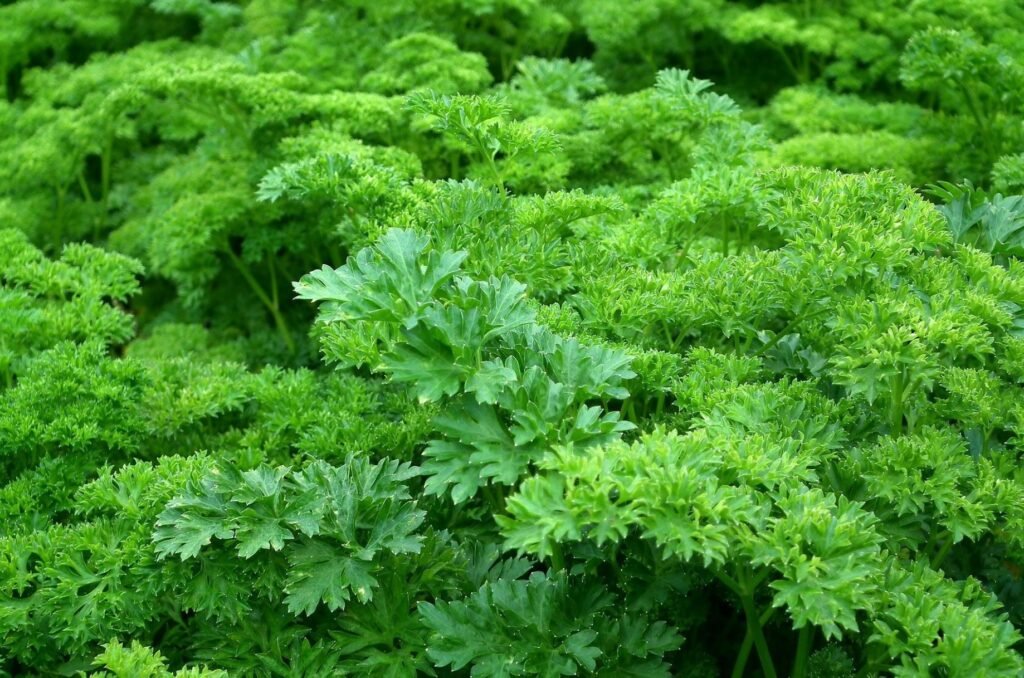
Parsley
PARSLEY (Carum petroselinum; Apium petroselinum; Petroselinum sativum; UMBELLIFERAE)
Common names: Parsley, garden parsley, rock parsley, common parsley, march.
Parts used: Whole herb; root, leaves, seeds.
- Therapeutic action:
- Culinary, aperient, diuretic (lithotriptic), tonic, antispasmodic, aromatic, expector, antiperiodic (juice), carminative (seeds), emmenagogue (seeds), febrifuge (seeds), vulnerary.
- This herb is used freely for culinary purposes and for garnishing dishes (where it is likely more nutritive than the concoctions to which it lends color), but the fact that it is a very reliable and old diuretic remedy is very much ignored today. Parsley will work on the gall bladder and will remove gall stones if used properly. Parsley is a specific for the adrenal glands, is powerfully therapeutic for the optic nerves, the brain nerves, and the whole sympathetic nervous system. The fluid extract or juice is an excellent tonic for the blood vessels, particularly the capillaries and arterioles. It is rich in vital minerals, and contains more iron than any other green, leafy vegetable. It is especially high in the elements known as vitamins A and B, and it contains three times the potency of C than do citrus juices.
- It is a remarkable remedy for expelling watery poisons, excess mucoid matter, flatulence, reducing swollen and enlarged glands, etc.
- Medicinal uses:
Dropsy, gall bladder problems, gall stones, gravel, aches in the lumbar region, menstrual obstructions, jaundice, enuresis, kidneys (congestion, irritation, inflammation), amenorrhea, dysmenorrhea, nephritis, cystitis, intermittent fevers (fresh juice, seeds), hepatitis, obstruction of liver and spleen, female problems, insect bites and stings, swollen glands, swollen breasts, cancer preventative, difficult urination, strangury (painful urination), syphilis, gonorrhea, dry up nursing mother’s milk, catarrh of bladder, anemia, tuberculosis, rheumatism, arthritis, acidosis, obesity, high blood pressure, catarrh, dyspepsia, halitosis.
- Preparation:
- Decoction, infusion, fluid extract, oil.
- Decoction: Use the roots only.
- Infusion: Used for preparing the seeds and leaves. When the parsley is dried, use 1 teaspoonful to each cupful of water; and if it is green, use a larger amount; a handful of the green to a pint of water. Always cover the steeping herb.
- Dosage:
- Parsley must be taken in larger quantities as a decoction and infusion to obtain benefit.
- Decoction (root)1/2 cupful 3-4 times daily.
- Infusion (herb)1 cupful 3-4 times daily.
- Fluid extract (root & seeds) 1 teaspoonful
- Oil 3-5 drops per day.
- Apiol 3-10 drops.
- Administration:
- Oral
Gall stones:
- Take 1 pint of the infusion daily.
- Kidney, bladder, dropsy:
- Make at least 2 quarts of the parsley root strong decoction and drink copiously.
- Dangerous suppression of urine:
- 1/2-1 teacupful (hot) every hour.
- Parsley green drink and tea:
- Parsley is terrific when blended with other greens as a drink. The reason we give the herb in tea form is that it will act rapidly, the capsules are slower. In some cases, we could not take enough parsley (or any other herb) to do us any good by just eating it in the raw form. Instead of using parsley straight, just make a tea with it. But if you are using parsley in the juice form, use it moderately; it is very highly concentrated and potent, and will work very quickly on the system. It will throw out the poisons too fast if used excessively, and can thereby cause serious upsets.
- Skin
- Dropsy:
- Mix equal parts of parsley root tea, and glycerine, saturate cloths and apply to swollen areas; keep patient warmly-covered in bed with tepid air circulation (this brings water through the skin and helps relieve the burden on the kidneys). At the same time, give the parsley root tea without the glycerine as a drink, 1/2 cupful each hour.
- Concussions, swollen breasts, enlarged glands:
- Apply a poultice of bruised leaves.
- Dry up nursing mother’s milk:
- Apply a poultice of bruised leaves to the breasts.
- Formulas:
- Gall stones:
- 1 ounce (dried) Parsley (Carum petroselinum) or 3 ounces (fresh)
- 1/2 ounce Wild Yam, fluid extract (Dioscorea villosa)
- 1/2 ounce Fringetree, fluid extract (Chionanthus viriginica)
- Preparation:
- Infuse the parsley in 1 pint of boiling hot water, cover and let stand until cool; strain and add the wild yam and fringetree; mix thoroughly.
- Dosage:
- 2 tablespoonfuls 3-4 times daily.
- Note: This will assist greatly in liquefying the bile and ease colic pains.
- Backache:
- 1 part Parsley root (Carum petroselinum)
- 1 part Carrot tops – garden variety (Oxheart, Chantenay, Nantes)
- 1 part Celery tops (Apium graveolens)
- 1 part Skunk cabbage root (Ietodes Foetidus)
- 1 part Juniper berries (Juniperus communis)
- 2 parts Senna (Cassia acutifolia, C. Marilandica)
- 1/2 part Wahoo bark (Euonymus atropurpureus)
- Preparation:
- Mix thoroughly; then use 1 teaspoonful of mixture to the cup of water and simmer 10-20 minutes.
- Dosage:
- 2 fluid ounces 3 or 4 times daily.
- Bladder stones:
- 1 part Parsley leaves (Carum petroselinum)
- 1 part Cleavers (Galium aparine)
- 1 part Juniper berries (Juniperus communis)
- 1 part Flaxseed (Linum usitatissimum)
- 1/2 part Ginger (Zingiber officinale)
- Preparation:
- Infuse in boiling water, cover and let stand until cool, and strain.
- Dosage:
- 1 or 2 tablespoonfuls 3 times a day.
- Kidneys:
- 1 part Parsley (Carum petroselinum)
- 1 part Juniper berries (Juniperus communis)
- 1 part Buchu (Barosma betulina)
- 1 part Flax seed (Linum usitatissimum)
- Preparation:
- Infuse one teaspoonful of well mixed herbs to each pint of boiling water, cover and let stand until cool, and strain.
- Dosage:
- 2 fluid ounces every one or two hours until relief; then reduce as required.
- Void urine:
- 1 part Parsley (Petroselinum sativum)
- 1 part Juniper berries (Juniperus communis)
- Preparation:
- 1 teaspoonful to the cup of mixed herbs infused in boiling hot water, cover and let stand until cool, and strain.
- Dosage:
- 2 fluid ounces or more each hour until relief.Female troubles:
- 1 part Parsley leaves (Petroselinum sativum)
- 1 part Buchu (Barosma betulina)
- 1 part Black Haw bark (Viburnum prunifolium)
- 1 part Cramp bark (Viburnum opulus)
- Preparation:
- Using 1 teaspoonful to the cup of mixed herbs, simmer slowly 5-10 minutes.
- Dosage:
- 1/2 cupful or more morning and night. More just prior to menstrual period.
- Babies soothing syrup (stomach and bowel pains, aches, cramps, colic, spasms, convulsions, flatulence, common ailments):
- 2 ounces Parsley seed, crushed or powdered
- 2 ounces Caraway seed, crushed or powdered
- 2 ounces Rhubarb, cut and dried
- 1 ounce Cinnamon bark, powdered
- 1 1/2 pounds Yellow D or Brown sugar
- 2 ounces Essence of peppermint
- 1 quart D-cell or distilled water
- Preparation:
- Soak the herbs 12 hours in the water; bring to a boil, cover and simmer slowly for 1 hour; strain and return to clean vessel; add the sugar and peppermint; cover and let stand until cold; bottle, cap tightly keeping in a cool and dark place.
- Dosage:
- 1 teaspoonful of syrup to the cup of distilled or D-cell water, or in a cup of mint tea.
Share this study
Help someone else discover this article.